Showing posts with label #howiseepc. Show all posts

Saturday, February 24, 2018

To See the World on a Wall

           I realize it's been quite a bit of time since I've posted on here and I have to apologize for that. Upon reflection, I realized that I had trouble thinking of what to post that would be interesting, engaging, and informative for those of you reading when my life here has become, while not routine, normalized, and experiences that would have once prompted a post are now accepted as everyday occurrences. Going forward, I will try to post more regularly but I make no promises.
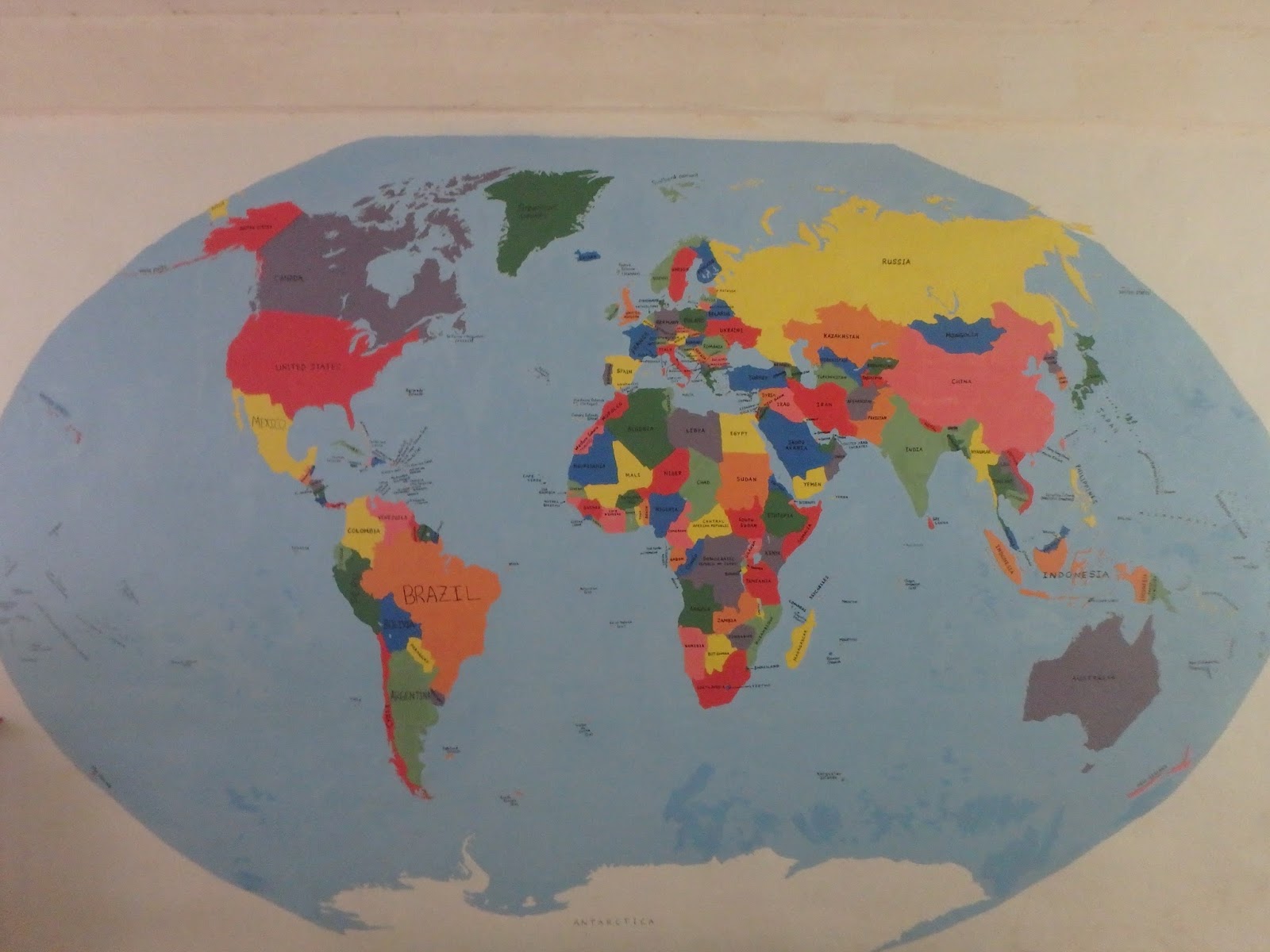
           One of the things that I have been working on the past few months is the World Map Project. This project was designed by a Peace Corps Volunteer serving in South America several years ago and is done throughout the world. I have wanted to do this project since before I even arrived in Micronesia and tried to start it last year but unfortunately wasn't able to start it until this fall. Since this project is a recognized Peace Corps project there is a handbook that gives advice, step by step instructions, and even teaching materials for math and social studies classes. 
           The first step of the project was picking a large, blank white wall that would fit a 7 1/2 ft by 12 1/2 ft map. Fortunately, the back wall of the social studies classroom was large enough and sheltered from the elements. Once I picked the wall, I had to find the middle to make sure the map was centered. This took longer than it should have (especially as the daughter of a carpenter) for several reasons; mainly I had no measuring tape and had to use a meter stick, which I thought was a yardstick and didn't realize my mistake until I had finished and then had to start all over again. Once I found the center I used a plumb line to draw the center line of the map and then drew the equator.

The boring blank wall.

           Then came the fun part, drawing a grid of 3 in x 3 in boxes. Again, this took longer than anticipated and I had to start over several times. The wall I chose was not level, the right corner was higher than the left, and the surface was not flat, making it incredibly difficult to draw straight lines without a level or tape measure. I got a lot of help from the school's librarian and our social studies teacher and finally managed to complete it. A few of the boxes weren't exactly 3 in x 3 in, either a little too large or a little too small, but fortunately none of them were off enough to completely throw off the map. 

The completed grid.

           After the frustrations of drawing the grid, the rest of the map was relatively easy. I readily admit that I am not a talented artist and even with the assistance of the grid and the handbook pages I had a bit of a tough time with some of the countries, especially the United States and Canada. I accidentally stole some land from Canada. Hey, as both my brother and dad said when I told them, 54 40 or fight! Also in my defense, the US was the first country I drew and didn't realize how out of proportion it was until the rest of the map was drawn and by then it was too late to fix. My favorite part of this step was how involved the students got with the project. The older students, 6th-8th grade, would help draw during their break and after school and took their assignments very seriously. The entire continent of Africa was draw by two very talented 7th and 8th graders and I was blown away by their accuracy and dedication. It was really humbling to see how involved the students were as well as how excited they were by the project.

8th graders working on the map.


Working on the map.

The picture isn't super clear but this the completed drawn world.

           The teachers and staff got their chance to shine when we started painting the map. Though students did help with the painting a little bit, mostly on the ocean and the larger countries, the teachers really took the project over at this point. There were times when I would come over to the map during my free periods to work on it and find so many teachers and staff members using their own free periods to help that I would have nothing to do. That was truly amazing. I didn't even have anything to do with the map for the last two weeks of the project as the teachers completely took over labeling the countries.

Teachers, staff, and students painting with many curious students looking on.

           To see the community involvement was incredible especially with the struggles I had trying to get this project off the ground last year. Everyone at the school took the project seriously and are very happy that it's completed, and I would like to think they are proud of themselves as well for the work that they did. Every time I see the map I get a little giddy that it's finally completed. I hope that this map will not only enrich the students' social studies classes but may inspire them to learn more about other countries and the world around them.

The completed map.

Friday, August 25, 2017

Facsin Friday - Orahluh Fukyah Kaki

          Today's very short Facsin Friday post is about how to make coconut oil, or kaki. Kaki is a major part of life here in Kosrae and is used for a myriad of different purposes. Coconut oil is good for cooking and is a great moisturizer, it's also really good for your hair, especially when it gets fried from the sun and swimming in the ocean all the time. My host mom will make a batch of kaki every couple of months and I managed to help this time, for at least part of it.
          The first step of making kaki is kwekwe kaki (grating coconut), a lot of coconuts. We use a small wooden stool that has a semi-circle of toothed metal on the end. The picture below shows my host sisters grating coconuts. Grating coconuts isn't particularly difficult, it just takes a long time and you have to grate a large number of coconuts when making kaki. The second picture shows less than half of the coconuts that we grated, there was another pile that I didn't get a picture of with even more husks.
           

Host sisters grating coconut and host mom squeezing ground meat to get milk.

A small portion of the coconuts we grated.

Coconut milk waiting to be boiled.

           After grating the coconut, you have to squeeze the meat to get the milk. The milk is then boiled over the fire. While it's boiling, a film appears on the top which has to be skimmed off and thrown away. My host mom will also add flowers to the oil which makes it smell really nice. This is about the point where my host sisters and I got really tired and accidentally abandoned my host mom to finish making the kaki. You unfortunately don't get a lot of coconut oil at the end of all of this, I think we only made a few 8 oz bottles of kaki. Since this is such a labor intensive chore with very little pay off at the end, more and more families in Kosrae no longer make kaki and instead buy bottles of kaki sold at various stores around the island. This is not an option in Walung, so most families still make their own kaki.
           I'm currently in Pohnpei for our Mid-Service Training (MST) and will try and post a regular update while I'm here as well.

Monday, July 17, 2017

Lessons From My First Year in Peace Corps Told Through "Moana" Lyrics

          I realized the other day that I have been in the FSM for more months than I have left in my service. This eye-opening realization as well as my past month helping with training, has led me to reflect upon my first year of service, what I've gained and the lessons I've learned. As I joked in an earlier post, the movie Moana is an accurate representation of my life on Kosrae, so I've decided to use the amazing lyrics to help explain 6 lessons I've learned or insights I've gained from my first year of Peace Corps service.
           Lesson 1: "You can find happiness right where you are" - Where You Are
           or "Conditions of Hardship" Really Aren't All That Hard.
           One of the core expectations of Peace Corps is that volunteers will "[s]erve where the Peace Corps asks [them] to go, under conditions of hardship if necessary, and with the flexibility needed for effective service." This essentially means that where you will be living might not be like your home in the States and may lack certain amenities, electricity, running water, etc. that we take for granted in the States. My site, Walung, is considered an outer island site by Post and has what many would consider "conditions of hardship." I have no electricity, my running water is from a river and undrinkable, my shower and toilet are outside the house (but enclosed), my drinking water is from a catchment, and I'm rather isolated from the rest of the island. Now, I recognize that these conditions are certainly much nicer than what many people around the world have and there might be other PCVs in different countries who have conditions worse than mine, but for my Post, these can be considered "conditions of hardship."
           I remember when I first learned about Walung that I was a weird mix of excited and terrified. While I have regularly gone on camping trips my entire life and am accustomed to spending time without electricity, running water, or cell reception, those trips were never very long, the longest trip was two weeks, I am also very much a child of the technology age and am used to being able to walk into a room after sundown, flip a switch, and have light. Now, I was about to spend the next two years living in a community where I wouldn't have access to things that I had previously taken for granted. On one hand, I couldn't wait to push my boundaries and test my limits. I was excited to experience something completely unlike everything I had grown used to. On the other hand, I was thinking, what have I gotten myself into? Would I be able to adjust? How could I go from living with constant access to electricity, internet, and clean running water, to, what seemed like at the time, nothing? I was scared that I wouldn't be able to handle the adjustment to a new way of living and I would quit. 
           Now, after not even a year of living in Walung, I am used to not having electricity, to taking showers outside, and only having internet once a month. Staying on Pohnpei at the moment, it's a little strange having electricity all the time and not having to worry about conserving the electricity from the solar panels. I've also found that constant access to internet is stressing me out and am very much looking forward to returning to Walung and my lack of "normal" amenities. I am quite happy living without conveniences that I formally took for granted. 
           I've learned that I'm a lot more adaptable than I previously thought and have learned that no matter where you are, either actual physical location or in the journey of life, it truly is possible to find happiness, and much of that comes from your perspective and outlook. 
           Lesson 2: "Consider the coconut / The what / Consider its tree / We use each part of the coconut / That's all we need" - Where You Are
            or You Don't Need A Lot of Stuff
           One of the hardest part of preparing for Peace Corps is packing. You are allotted two checked bags, 50 pounds each, and two carry-on bags, to bring the clothes and other supplies you'll need for the next two years. Fortunately, the FSM only has one season, summer, so unlike other PC countries, Mongolia for example, I didn't need to pack heavy duty winter clothes as well as summer clothes. Nonetheless, I was definitely stressed about packing and bringing everything I thought I might need. Over the past year, wearing the same 10 skirts and 12 or so shirts on rotation, living with a host family that doesn't have knick-knacks, and watching kids in Walung play ping pong using a piece of plywood propped on an old desk, with a two by four as a 'net' and handmade ping pong paddles, or fish by wrapping line around an empty beer bottle or soda can, I've realized that 'stuff' really isn't important. Sure, I've heard truisms like material things can't make you happy, and read articles about how many, frankly, useless possessions Americans, in general, have but I never really and truly thought about it until now. 
           Coming from a country where people with cell phones in perfect working condition will start lining up outside Apple stores at 4 in the morning to get the latest upgrade to a country where children play games with nothing more than lines drawn in the sand has truly opened my eyes to how materialistic the Western world has become. Sure, there are days when I get really tired of wearing the same things all the time, or I would love to lie down on a couch, but at the end of the day, things are just that, things. What matters more is your family, your friends, and your experiences. Not having a lot of 'things' means that kids in Walung have to be more creative and inventive in their games. I'm constantly blown away by how inventive the kids can be and am honestly amazed at what they're able to create. 
          While I've never been someone to place a lot of emphasis on objects, I didn't get a smart phone until after I graduated from college, I'm certainly much more aware of the things I own now and whether or not they are truly meaningful or empty objects. Going forward, I see myself being much more conscious of what I own and making smarter choices about what I decide to buy.
           Lesson 3: "We share everything we make, we make" - Where You Are
           or Community is Incredibly Important and Sharing Really is Caring
           One of the many things I love about Walung is how close everyone is in the community. Within 24 hours of my arrival in Walung, I'm convinced that everyone knew who I was, where I was from, and how many people were in my family in the States. Community and family really are everything in Kosrae and nothing shows this more clearly than the cultural norm of offering food to anyone who walks past your house. On my 5 minute walk from my school to my house I normally hear at least two offers of food, every day, no matter how many times I say that I'm either not hungry, or going to eat right now. It doesn't matter to my community members whether or not I'll eat, what matters is that they care about me and are showing it by offering me food. In a society where food scarcity used to be, and still can be, a real concern, offering food to your neighbors is the ultimate sign of caring.
           Another tradition is to share food among community members. My host family for example, will make a lot of breadfruit in our um (traditional fireplace) on Saturday to eat on Sunday and will often share our breadfruit with other families and receive traditional cooked bread (which is delicious) or other dishes. Sharing food is the Kosraean way of showing that you care about a person. 
           The importance of community in Walung is also evident in other ways. Community members will go fishing together, share extra fish they caught with their neighbors, or help with building projects. Almost every Saturday is spent working at the church and almost every community member is there, including the little kids. When my host family was re-roofing our traditional kitchen, various community members stopped by to help make the thatching or worked with my host brothers to place the thatching. All of this work was done with no expectation of reward or recompense. Community members help each other, it's just the way it is. 
            I've always placed an incredible amount of emphasis on family and believe that strong family relationships are incredibly important and know that I wouldn't be who I am or where I am today if not for my family. Until now, however, I hadn't thought much about the importance of community. My experiences this year have taught me that community is almost, if not just, as important as family and helping others for no reason other than that they are your neighbor or community member is a reward in and of itself. In a world that is growing increasingly polarized and with countries shutting their borders to refugees fleeing wars and terrorism, it's time for all of us to remember how important community is and that community extends far beyond your neighborhood, city, or even your country. Our world truly has become an international community and when we remember that and do our best to help our most disadvantaged community members we will all be the better for it.
           Lesson 4: "We read the wind and the sky when the sun is high / We sail the lengths of the seas on the ocean breeze" - We Know the Way
           or Have Patience.
           I admit, the lyrics here are a bit of stretch but I figure that sailing across the vast expanse of the Pacific Ocean looking for islands has to test one's patience. I freely acknowledge that I am not always an incredibly patient individual. I get easily frustrated when things don't work out the way I want, often want immediate results, and have trouble understanding why things can't be the way I want when I want. At least, that was me before serving in the Peace Corps for a year. 
           While I still get impatient at times, I do believe that I have become more patient than I was before and much more understanding when things don't work out. I've adopted a much more laid back approach to life when things don't work out, since things rarely work out the way you want them to here. Instead of stressing myself out and feeling like a failure, I know shrug, tell myself that it sucks and is unfortunate, and then get ready to wait. Things rarely work out exactly how you want or when you want and I've had to adjust my personality and outlook to mirror that. I've really come to embrace the philosophy that life is too short and instead of worrying about things I can't change. As an example, I planned a project in my community that required four different colors of paint and since I rarely leave my community, I asked another community member to get the paint for me. When I finally received the paint, the three cans that were meant to be colored, were white, no color had been added. While I was understandable a little upset, I had been trying to complete this project for 4 or 5 months at this point, I shrugged, asked that if he or she had a chance, could they pick up the colored paint the next time they were in town, and got ready to wait. Two months later, I'm still waiting. I'll hopefully be able to complete the project around the start of school, which I'm okay with. In the grand scheme of things, as long as the project gets done, what's the big deal of a few months wait?
           Lesson 5: "I am everything I've learned and more / Still it calls me / And the call isn't out there at all / It's inside me" - I Am Moana
          or I Have a Better Idea of Who I Am and What I Want to do With my Life
          Similar to many 20-something-year-olds out there, I still don't really know what I want to do with my life. One of the reasons I joined Peace Corps was to contribute meaningfully to the world while giving myself the chance to really think about who I am and what I want out of my life. Prior to joining the Peace Corps, I was considering a job in education, but having had no classroom experience, I wasn't sure if that was what I really wanted to do. I figured that the Peace Corps would let me know for sure if teaching was right for me and, if it wasn't, give me time to reflect on my life as well as many opportunities to do other projects that might lead me in the right direction. 
          Now, a year into my service, I've come to the conclusion that teaching probably isn't in my future, at least not teaching English, and while I'm still not sure the exact career I want, I know that I want something that is international and helps others. I know that I can't spend my life working in a 9-5 office job that doesn't provide meaningful work. I know that there's still so much world out there and I want to see and experience as much of it as I can. I know that I am incredibly privileged to have received the opportunities and education that I have and that I have the ability and opportunity to help others help themselves and I could not live with myself if I was too selfish to do so. I know that our world's problems are complex and multi-faceted and won't be easily solved. But I also know that they will never be solved if we're too scared by their complexity to even attempt a solution. I know that my future is wide open and it's up to me to decide its direction. Whether all of this means working for an international non-profit or NGO, or for the US government in some other international capacity, I don't yet know but I have plenty more time to think about it and will, hopefully, have it figured out by this time next year. 
           Lesson 6: "And yes I know that I can go / There's a moon in the sky and the wind is behind me / Soon I'll know how far I'll go" -How Far I'll Go Reprise
           or I Am Much Stronger Than I Realized
           One of my most treasured belongings is a necklace my parents gave me for Christmas a few years ago inscribed with a quote from Christopher Robin that reads "promise me you'll always remember you're braver than you believe, stronger than you seem, and smarter than you think." While I always try to have the self-confidence the necklace implores me to have, there are times when I doubt myself, like most people. One of those times of self doubt was spring of last year. Prior to coming to Micronesia, I freely admit now, as I didn't then, that I was terrified. I was scared that I wouldn't be able to handle the pressures and stresses that come with Peace Corps service and that I would early terminate (ET). I was scared that I wouldn't be able to integrate into my community and would spend two years being absolutely miserable. I was terrified that I was making the worst decision possible and was about to waste two years of my life and have nothing to show for it when I came home. I was worried that I wouldn't be able to cope with not having regular contact with my family and friends. Mostly, though, I was scared that I was going to be a failure. 
           A year later I have faced those fears and come out the stronger for it. Yes, this past year has been incredibly difficult at times and there are times when I wonder if what I'm doing is making a difference or if I wouldn't be happier back home. There are times when nothing seems to go right and all I want is to hear my mom's voice telling me it will be okay or my dad telling me that this whole thing is just AFGE (another freaking growth experience). I want my brothers to give me advice on how to handle a certain situation or my friends to make me laugh. But, I can't call my parents, or ask my brothers for help, or have my friends tease me. Instead, I have myself and my host family and community. I've learned to rely on myself for guidance and encouragement, to pick myself when I fall, and to remind myself, that yes, I am making a difference, and absolutely yes, this was worth it. I've learned to let my host family and community help me, even if it's just playing and laughing with the kids for an hour when I'm having a rough time. At the end of the day, I am stronger than my fears and so much more capable than I believed myself to be. I am confident that no matter what life throws my way, I'll be able to handle it, with or without help. 

Thursday, June 22, 2017

Yap Vacation

         After more than 9 months on Kosrae, I am finally off the island. Don't get me wrong, I love Kosrae, but 9 months anywhere, much less a tiny 42 square mile island, can drive even the most sane person a little batty. For my chance to get away I decided to go from one tiny island, Kosrae, to another even smaller island, Yap.
        For those who don't know, Yap is one of the four states in the FSM and is the farthest from Kosrae. It is also the most traditional of the islands as the Yapese were able to preserve more of their culture and traditions than the other three islands. Before I came to the FSM, I had wanted to be placed on Yap because of the culture and history and am glad that I get to experience a small part of it on this vacation. Through lucky coincidence, Sorcha and I picked the week of the Yap Homecoming Summer Festival for our visit. The Festival is a two day event that celebrates Yapese culture and promotes tourism. Over the course of the two days there are several traditional Yapese dances, canoe rides and chances to buy traditional crafts.
        The Festival started on Friday so we had two days before hand to do other activities. I went diving on Thursday, and despite a few complications, had an amazing time. I saw a manta ray and was blown away by its size. I also saw four small sharks which were really neat. I don't have very many pictures because my camera broke a few weeks ago and so the ones I do have are taken from Sorcha.
Manta Ray

If you look closely, there is a shark in this picture. It's dead center towards the back of the photo, right in front of the coral head.


        Friday started bright and early with a short hike with Sorcha and Olivia, another volunteer from our group that serves on an outer island of Yap and came to Yap proper for the weekend, that gave us amazing views of the island. Towards the end of the hike there was a small spur off to the side that ended at a small WWII monument. There were three American planes shot down over Yap by the Japanese at the end of the war and the monument marked the spot where the plane went down and was discovered in 2006.

Wreckage and Grave Marker of Downed WWII Plane

         After our hike, and a trip to the hospital to get Benadryl, we visited the Yap Living History Museum, where the Homecoming Festival was going on. We watched a traditional stick dance in the early afternoon and a men's dance in the evening. Though I love Kosrae and am really happy with my placement, I do feel that I missed out on a chance to really experience Micronesian culture by living there, and am really happy that we got to see the traditional dances. The dances are passed down through the generations and kids start learning the dances when they're around 4 or 5 years old. Sorcha has a video of the dances and if I ever have strong enough internet, I'll try and post it as I find myself unable to accurately describe them.

Start of Traditional Men's Dance


         The rest of our time in Yap was mostly spent relaxing and sleeping. I often find myself exhausted as serving as a Peace Corps Volunteer can, at times, be very draining, so it was nice to have time when there wasn't anything I had to do and could spend time reading or catching up news from home. One of the highlights of our trip to Yap was meeting Greg and 'Toby,' two gentlemen in Yap to defuse a 500 pound WWII bomb. They had both served in the US military, were avid divers, and had many fascinating stories to share. It was really cool to sit with them at dinners or during Happy Hour and hear everything they'd done, seen and experienced. I can only hope that when I'm their age that I have stories that are as interesting as theirs.


Saturday, May 20, 2017

Scuba

 I was fortunate enough to finish my scuba certification this weekend while in Lelu for our monthly meeting.  I am now certified for open water, which means I can only go to a maximum of 60 ft. Over two days, I did 4 dives, the first 2 to 30 ft and the second 2 to 60 ft. The first dives were done in Lelu Harbor and had really bad visibility. The first dive was over a wreck of a WWII Japanese cargo ship and the second was over the small reef in the harbor. The third and fourth dive were both done by Okat Harbor and were done over the coral wall. I'm struggling to find words to accurately describe the experience and I figure a picture's worth a thousand words, right? A few thoughts before we get to the pictures though. I was constantly surprised by the scale of the coral, it was much larger than I thought it would be. There's also something a little surreal about floating through the water and watching large schools of fish swimming over your head or right below you. This experience is probably in my top 5 of coolest things I've done and I'm excited to dive more here and in Yap.

Now, to pictures.

These are all from the wreck dive, and as stated above, the visibility wasn't great.


The pictures below are all from the 3rd and 4th dive over the coral wall near Okat Harbor


Thursday, May 18, 2017

Typical Day in Kosrae

While this post is late in coming, school's over already, several people have asked me what my everyday schedule is like, so I figured it's better late than never.

Similar to training, my day stars early, and as I said in an earlier blog post, I've become a morning person, much to my shock. So, I wake up around 6:45 and head to school by about 7:25 (yes, I do have my morning routine organized to the minute). My breakfast varies from pancakes to cereal to muffins to banana tempura (one of my favorites) depending on if my host mom is awake and cooking.

My walk to school is only about 5 minutes or so and I'm usually the first teacher at school. Whether or not I can get into my classroom depends on if I have the school keys. Some days the keys don't get to school until after school was supposed to start, which can be frustrating and make getting ready for the day a little difficult. As many of you know, I co-teach four classes - English Reading for 4th, 5th, and 6th grade and English Writing for 6th grade. My classes are quite small with 4, 6, and 6 students respectively, which has its benefits and its challenges; classroom management is easy but trying to vary group sizes or members for projects is, well, not possible. Classes are usually about 45 minutes, unless we have a special schedule, so I teach from 8 to 11:10.

After my classes are over, I hang out in the library, either reading, grading homework or tests, or planning for the next day. When school ends at 1:25, I plan with my two co-teachers for the next day. This can take anywhere from 15 minutes to 45 minutes, depending on what we're going to do the next day. Co-planning is a major part of my job as a Peace Corps Volunteer because it builds capacity, a major goal for all Peace Corps Volunteers. That being said, co-planning doesn't always work and has been a pretty big struggle for this past year, and something I'm planning on improving for next year.

I'm usually back to my house by 2 and either make lunch for myself, tuna with rice, or eat whatever my host mom has cooked, which varies significantly from day to day but is all pretty delicious. After lunch I usually take about 45 minutes to an hour for myself, either hanging out in the kitchen with my host parents or reading in my room. I try to spend as much time with my community members as I can, which normally translates to playing with the kids or going for walks through the village, usually with the kids as well. I also try and do yoga or, more recently, zumba, for an hour everyday, usually in between 4:30 and 5:30.

My dinner is usually around 6:30 since it starts getting dark between 6:30 an 7, though since it's summer it stays lighter for a little bit longer than that now. After dinner, I spend more time with my host parents and am in my room by about 7:30. I read for about an hour or so and am in bed most nights before 9.

With school ending, I'll have to find a new routine for the summer, or at least for part of it. I was recently chosen to help teach Kosraean to the new volunteers coming to Kosrae and will therefore be in Pohnpei from June 20th to July 22nd. Prior to that, I'm hoping to go on vacation with Sorcha, the other M82 on Kosrae and my closest friend here, to Yap for a week. At the moment, things are still a little up in the air concerning the vacation because of the training dates, so we'll see how that goes. After training, I'll have about 2 or 3 weeks before school starts up again and am hoping to have some sort of activities for the kids in Walung, though it may be difficult to plan while I'm out of site.

It's hard to believe that I've been in country for almost a year now and new volunteers will soon be arriving in Pohnpei. I can remember how nervous, excited, and yes, slightly terrified, I was this time last year and it's amazing to see how much has changed and how much has still stayed the same. I have fallen in love with Kosrae, Walung and the people in my community, and I'm excited for the year ahead. At the same time, it's a little bittersweet knowing that the M81s will be leaving this summer and that this my last year here. I still have so much I want to do here and hope that I can get it all done in time. 

Friday, March 10, 2017

Highlights!

Since I haven't been able to provide periodic updates of the past few months, I've decided to share one or two highlights from each month I've been in Kosrae. I also received a question on my last post about what kids do for fun so I'll answer that here as well.

September - Liberation Day Canoe Races

First, what exactly is Liberation Day? Liberation Day is a three day holiday celebrating the Americans liberating the island from Japanese control at the end of WWII. Japan had had control of the island for several years and the Kosraeans suffered greatly during those years. Towards the end of the war, supplies were running low and there was not enough food on the island for the Japanese soldiers and the Kosraeans. The Japanese military leaders decided it was necessary to kill the Kosraeans in order to preserve the meager supplies they had. There were two seperate plans to kill the Kosraeans, the first was to host a boat race in Lelu harbor and then have Japanese sodiers open fire from the shore and the other was to order the Kosraean men to dig tunnels in the mountains, order an evacuation and then kill the Kosraeans that ran to the tunnels. Fortunately, a few Japanese soldiers warned the Kosraeans what was planned and the potential slaughters were avoided. A few days later, American forces arrived and the Japanese surrendered. There is a lot more information about the Japanese presence on the island I could share but this blog is not the right place for that, there is information on various other websites so if you are at all interested, go ahead and check them out.

To celebrate Liberation Day, each of the four villages, Tafunsak, Lelu, Malem, and Utwe, hold different sports competitions between each of the hamlets or sections of the village over the course of the three days. There are volleyball games, speed boat racing, and on the last day, canoe racing. Walung is technically part of Tafunsak so we competed against the other three sections of Tafunsak, unfortunately I forget the names. There are four person and two person canoe races in traditional out-rigger canoes and it is very competitive. Practices had already started when I got to Walung and I was immediately conscripted, not that I was complaining. We had practices usually twice a day, if tide was high, for about a week and a half before the races. On race day, everyone went to Okat Marina, which is right next to the airport and where boats going to and coming from Walung dock. The races started around 9am and went all day. There were four man and two man races and four woman and two woman races.  I was in the boat with my host mom, one of host sisters and one other person. We had been the slowest boat during practices in Walung so no one really expected much from us. All I was concerned with was not tipping the canoe over or completely embarrassing myself one way or another. It turns out, we won! We were the first boat from Walung to win a race that day! It was definitely an experience and there's even a video of it which I will try to post.

 October - S'mores with my family

The highlight for October wasn't Halloween or another canoe race. Instead it was a really simple night but definitely one that I'll remember forever. About the second week or so of October, a group of World Teach volunteers came to Walung for the weekend and happened to bring s'mores stuff with them. I had hung out with them a little bit and when they left, they gave me a bunch of their extra food, including the s'mores supplies. My host siblings had never heard of s'mores before and I figured this would be a perfect time to share a small part of my culture that, personally, is pretty important to me. I know, you're probably thinking, how can s'mores be important to you? Yeah, they're delicious but it's marshmallow, chocolate and graham crackers, nothing particularly earth shattering there. For me, s'mores always remind me of childhood camping trips, summer nights chasing fireflies in the backyard and the annual family Piney-Mo camping trip. It turns out, the weekend I made s'mores with my host siblings was the Piney-Mo weekend back home and my real family was probably enjoying a s'more or two as well.

Anyway, back to the actual making of the s'mores. We didn't have graham crackers unfortunately, but we got creative and used chocolate chip cookies and knock-off Oreos instead, definitely pushing the bounds on sugar intake there. My host brothers made a small fire in a metal basin and we sat on the beach under a full moon while I taught them how to make s'mores. Eventually, some of the other kids in the village wandered over and my host siblings got to show off their newly acquired s'mores making knowledge and teach the newcomers how it's done. I remember standing on the beach, watching my host siblings making s'mores, fighting over the chocolate of course, and thinking that I can't believe this is my life right now.

I'm asked pretty regularly by the kids in the village when we're going to make s'more again, so I'm sure it will happen again soon.

November - Thanksgiving

Thanksgiving is one of, if not my favorite holiday, mainly because of all the family traditions, and this was my first Thanksgiving away from home. It was definitely a little hard being away, but since it didn't feel like the New England November I'm used to, it wasn't too difficult. Fortunately, in addition to the other PCVs, there were World Teach volunteers, and Seabees from the Navy, so we had our own ex-pat Thanksgiving.

While Thanksgiving isn't a holiday in Kosrae, there happened to be a Kosraean holiday on Thursday, so we had no school Thursday and my principal decided to cancel school on Friday as well since most of Walung was going to Lelu to celebrate. As a bit of a last minute decision, I decided to spend Thursday and part of Friday in Lelu. On Thursday morning, the Seabees had a flag football game and invited all the volunteers and various ex-pats to join, including an Australian and Japanese volunteer. As a touch football game was always part of the family Thanksgiving tradition, it was really nice to continue that here, even if it was incredibly hot. The World Teach volunteers live in their own house and so they hosted a Thanksgiving potluck that night, which including dishes varying from sashimi to genuine mashed potatoes. It was not quite the traditional Thanksgiving dinner but it was certainly special.

In addition, through careful planning and coordination with my brothers, I got to surprise my parents with a Skype call on actual American Thanksgiving and was able to talk to a lot of my extended family.

December/January - Christmas and New Years

I have an entire post about Christmas and New Years so I won't repeat myself here. If you haven't read it already, check out 'Christmas Craziness' to learn about Christmas in Kosrae.

February - Lime picking

The highlight for February was actually a chore that my host siblings and I had. One Saturday we went to pick fresh limes, which sounds simple enough, right? Not quite. We had an hour long walk to the first lime tree, most of which was along the dirt road from Utwe to Walung. This was the first time I had seen the road and I was not prepared for what I saw. About three quarters into the walk, my host brother turns to me and asks if I'm ready. I responded, ready for what? He just laughed and kept walking. As we rounded a bend, we came to the bottom of a hill that seemed to go straight up. It was one of the steepest roads I've ever seen and I would never want to be in a car going up or down the hill. The walk to the top was not easy but the view was incredible. You could see for miles and seeing Walung from above was really cool. Unfortunately, I forgot to bring my camera and so have no pictures to share but I'm sure that I'll walk the around again at some point in the next 18 months.

Once we got to the top of the hill the walk was easy and not too far from the lime trees. Lime trees have really sharp thorns, which I was not aware of before this, so you can't just grab the limes. Instead, my host siblings used a long pole with a nail hammered a little bit more than half way through to essentially yank the limes from the tree. While one or two people are using the poles, the other two of us pick up the limes as the land on the ground. We spent about an hour and a half at the first tree, and then walked another 15-20 minutes to the next tree, which required some clambering over rocks and through a stream to get to.

Once we finished picking the limes, we hiked out to a channel where my host dad picked us up in the boat and even brought lunches that my host mom had made. This 'chore' was a great bonding experience with my host siblings and definitely a highlight of my service so far.

March - Scuba Certification 

I know March has pretty much just started, but I just started my scuba certification today, and will finish it by the end of the month. I had an hour long class this morning, which included four quizzes and a final exam, and then the first 'dive.' Most of the dive was were I was able to stand, in case I panicked or something went wrong, but actually having all the gear on and breathing through the regulator was really cool. For part of the dive we got to swim out into slightly deeper water to practice swimming with the gear and breathing properly and some of the fish I got to see were incredible. Mark, the instructor (and co-owner of Tree Lodge), was absolutely amazing, going slowly enough that I could follow along and checked constantly that I was comfortable and everything was okay.

By the end of the month I'll have my PADI Open Water Recreational Dive certification and am already planning on taking more classes to gain further certification, though that might have to wait until after Peace Corps.

Miscellaneous - What do the kids do for fun?

Aunt Sarah asked on my last post what the kids in Walung did for fun and I was already planning on post about that so I decided to include it here. The kids in Walung are similar to kids in the US, though they do spend more time outside and less time on electronics. They do enjoy playing games on tablets and watching movies but due to lack of electricity, they mostly spend time outside.

One of the major activities is fishing. The kids will take soda cans or empty beer bottles, wrap them in fishing wire and tie a hook to one end. They throw the line out similar to a lasso and then wait for the fist to bite. This takes considerable patience and usually involves kids as young as 7 or 8 using large knives to cut up small fish for bait. I'm constantly impressed by the patience as well as the skill the kids display in using the knives safely.

If the kids aren't fishing or playing ping pong, highly popular, they play a game they call Inside. The first time I saw them play Inside was my first weekend in Walung and it took my forever to figure out what was going on. To play Inside, you need a sandy space about 10 feet wide and 15 feet long, and at least 6 people. The 'field' is divided into four squares with two base lines, two side lines, and one vertical and one horizontal cutting the space into four squares. The 6 people are then divided into two teams, offense and defense. The offense wants to run from one base line to the other and back, without getting tagged. The defense wants to tag the runners, but have to keep one foot on either the base line, or the horizontal or vertical lines, but NOT the side lines. There is lots of shouting and yelling involved and can be difficult to follow if you don't know the rules. I've played a few times but am definitely amateur status to the kids pro status.

One of the other, less boisterous activities involves throwing rubber bands. To play, one person tosses a rubber band about 3-4 feet in front of themselves and then alternates throwing with their opponent or opponents. The object is to get one of your rubber bands to overlap with one on the ground. When this happens, you get to pick up all the rubber bands that have been thrown. The kids will often play this before school or during break, if they aren't playing ping pong.

And last but not least, is swimming, as one would expect from kids living on an island in the Pacific. The kids will spend hours swimming, usually in whatever clothes they happen to be wearing.

I hope this post gave you all a better idea of what my life has been like since I got to Kosrae and as always, if you have any questions, leave a comment below and I'll try to answer it as soon as I can.

Thursday, March 9, 2017

Facsin Friday: Orahluh Fuhkyah Tapioca

It's Friday which means it's time for a Facsin update! Today's title Orahluh Fuhkyah Tapioca translates to How to Make Tapioca. Tapioca is one of the few traditional dishes I've learned to make so far and the first dish I learned to make. Tapioca is a very popular dish in Walung and there is almost always at least one variety at every big village event. There are different versions of tapioca and while it's very time consuming, it's relatively easy to make.

Once the tapioca is gathered, usually by my host dad or brothers, we have to remove the outer skin. To do this, we soak the tapioca in water, double purpose of cleaning the tapioca, then slice the both ends off the tapioca and then make a vertical cut. Once the cut is made, you peel off the outer layer of the tapioca. I usually use a spoon for this step because getting the skin under your nails really hurts and it doesn't always peel off easily. Once we've removed the skin from all the tapioca and washed them, it's time to grate. You don't want to grate the entire tapioca because center is quite hard.

Once the tapioca is grated, you have to remove the liquid from the tapioca. There are two ways to do this, depending on how much tapioca and how much time you have. For the first method, we fill up a pillowcase (only used to make tapioca) and hang it from one of the beams in kitchen with a pot placed below it. Between gravity and the weight of the tapioca, the liquid is squeezed out of the tapioca. The second method is more labor intensive but much quicker. Still using a pillowcase, we put about 5-6 cups of tapioca into the pillowcase and then manually squeeze the liquid out. After the liquid is separated, we add sugar and coconut milk to the tapioca and mix it by hand. We also add the 'starch' from the tapioca liquid, a semi-solid white substance that settles at the bottom of the pot. Once the tapioca mixture is sufficiently sweet, it's time to wrap it. How you wrap it depends on what type of tapioca you make.

The first type of tapioca I learned to make in Walung, my second or third weekend, is tapioca usr (tapioca banana) and is a highly traditional dish. This dish is made by slow cooking in the traditional fireplace and is wrapped in banana leaves. To make tapioca usr, you place a small amount of tapioca in the middle of the banana leaf, then two pieces of banana (cut vertically) and then cover the banana with more tapioca. Then, you fold the leaf, sides in first, then bottom up and top down. Once all the tapioca usr is wrapped, the bundles are placed on super hot rocks in the traditional fireplace and covered with larger leaves and are left to cook for a few hours. As it's a traditional dish, only women are allowed to make tapioca usr, though the men can help placing them on and removing them from the fire.

Normal tapioca is slightly easier to make and doesn't take as long to cook. Once the tapioca has been mixed, food coloring is added and then the tapioca is wrapped in tin foil. Each foil wrapped tapioca is only about 6-7 inches long. This version of tapioca is placed in a large pot and steamed over the fire.

As I said before, tapioca is simple to make but time consuming between grating the tapioca, grating and making the coconut milk and the mixing and wrapping the tapioca. I've since learned to make a few other traditional dishes, including sihkyahki, my favorite Kosraean food. I'll post another Facsin update about how to make sihkyahki later this month. I also plan on sharing a Kosraean language post to share some basic vocabulary and explain the different vowels and consonants.

If you have any questions about Kosraean culture or traditions, even ones I haven't posted about yet, please let me know! 

Friday, February 10, 2017

Christmas Craziness!

           Christmas in Kosrae is a big deal. A very big deal. Preparation for Christmas starts about two weeks before Christmas Day, though the countdown begins in September. Kosraeans celebrate Christmas quite a bit differently than Americans and it was certainly an interesting tradition to experience. Christmas this year was special as Kosraean churches from Pohnpei, Guam, the Marshall Islands, and the United States came to Kosrae for a HUGE celebration that happens every four years.
           Kosraeans celebrate Christmas by marching and singing in church, think marching band with no instruments, and they take the marches very seriously. As I stated above, we started practicing our marches about two weeks before Christmas and practiced every day but Sunday from 7 pm to around 11 pm. The marches were divided into several groups including the children, Etawi Fusr, Woman's Chorus, Men's Chorus, older adults, and the whole church. Since this was a special year, we had two separate celebrations, one just for Walung and the larger celebration, which means we had to learn even more marches.
           One of the most important parts of the marching is the stars, or etu. Each church is given an assigned number of stars depending on the size of the church. Stars are usually carried by the high schools girls, but in Walung there are 20 stars and not enough high school girls so the stars varied from middle school girls to college students. I was chosen to carry one of the big stars, etu luhlap, and therefor as one of the leaders of the marching. It was the first time a Peace Corps Volunteer had been chosen to carry a star and I'm incredibly honored that my village chose me.

Etu luhlap

          Walung had its celebration on the Thursday before Christmas and it was a lot of fun to watch all the marches, and dodge the candy that was thrown at the end of each march. Since actual Christmas was on Sunday the big celebration was on the following Tuesday to ensure everyone had enough time to practice and Tafunsak Church, who was hosting, was able to decorate and set everything up for the celebration. We had two practices in Tafunsak before the actual event and, if I wasn't already nervous enough, our march was changed the day before the celebration. I had struggled to remember all the moves and learn the song we were singing, in addition to be pretty sick, so the last minute changes did not make me very happy.
          The order of the marches weren't decided until the morning of the celebration and when Walung was assigned to go first it led to a lot of last minute scrambling to get ready. The actual marching was a bit of a blur as I was trying to get through it without messing up, which I did anyway, twice, but the rest of the day was a lot of fun. All of the other PCVs were at the celebration, including one of our friends who was visiting from Pohnpei, and it was fun to watch the other 13 marches and spend time with the other volunteers. The celebration started at 9:30 in the morning and didn't end until after 1 in the morning, though luckily I was able leave early with the other volunteers. Unfortunately, I ended up losing my voice from a combination of being sick, singing, and talking way too much with the other volunteers, but it was totally worth it.
           In addition to the church celebrations, we also had a Christmas celebration for school. The grades were divided into clusters, ECE-2nd, 3rd-5th, and 6th-8th, and each cluster performed a song or two for their parents and the rest of the community. The teachers sang as well, so I now can sing Silent Night in Kosraean.

The 3rd-5th Graders at School Christmas

          One of the highlights of Christmas break, was the chance to see my friend, Matt, who's a volunteer on Pohnpei. Matt, Sorcha, and Ashley came to Walung for a night and it was great to spend time with each other and have a chance to catch up. I also got to show my village to my friends and introduce them to my host family. On Friday, before heading back to Tafunsak, we went on a hike with my host siblings, Ahok, Srue, and Titan, to a waterfall. The hike took about an hour and a half and was a bit of a challenge as we were hiking barefoot and had to spend a lot of time walking up creeks, with a lot of falling down. At the waterfall there was a pool large enough to swim in and it was cold! It was really refreshing to swim in cold water after a hard hike and it was great to spend bonding time with my friends and my host siblings.

Ahok, Srue, and Titan at the waterfall

Waterfall

         On a side note, I highly recommend that everyone watch the newest Disney movie, Moana, as soon as possible, I think I've seen it 4 or 5 times already. Not only is the music amazing but the island life is very much like Kosrae, especially Walung. It's hugely popular here and it reinforces the importance of representation in media and entertainment. This is the first movie my students have seen when they actually look like the person in the movie and can understand all the references. Anyway, issues of representation aside, the movie is great and everyone should watch it. 

Thursday, February 9, 2017

Facsin Fridays: Alu

           Every Peace Corps volunteer has three goals they hope to accomplish, regardless of the sector they serve or the country in which they serve. The first goal is capacity building and skills transfer, which for me means working with a teaching counterpart and passing along English and teaching skills. The second goal is to teach host country nationals about American culture, such as Thanksgiving. The third goal is to teach Americans about the culture and traditions of the country in which the volunteer serves. In an effort to teach my, admittedly limited, reading audience about Kosraean culture I have decided to post periodic culture posts. The title of each post will be Facsin Fridays, as facsin (fay-seen) means culture or tradition and I'll hopefully able to post on Fridays.
          The rest of the title of this post, Alu (all-u) means church in Kosraean, one of the most important parts of Kosraean culture. Before talking about church in modern culture I'll need to give a short history lesson to put things in perspective and I'm a history nerd so I found all of this extremely interesting. The Christian church didn't appear in Kosrae until the mid-1800's and prior to the arrival of the missionaries, Kosrae was a polytheistic, matrilineal society. One of the few remaining ancient ruins in Kosrae are those of a temple to Singlaku, the Goddess of Breadfruit. 
           The first European contact occurred in the 1820s and shortly after, Kosrae became a stopping place for whale ships in the Pacific. The consistent contact with the Westerners led to the transmission of many diseases to which the Kosraeans had no immunitiy. As a result, the population of Kosrae plummeted to about 300 and much of the traditional way of life and culture was lost. The first missionaries appeared in Kosrae in the 1850's, and by the 1870's the entire island had converted to Christianity. Today the church is the most important part of Kosraean culture and is a major part of daily life.
          Sunday in Kosrae is rest and church day. To start, traditionally, there is no cooking over a fire during the daylight. I'm sure some of you are saying, wait, Devon, you don't have a stove, you have to cook over a fire, how do you eat on Sundays? On Sundays, my host mom will wake up really early and cook a big pot Kosraean soup or fry fish, which we will eat throughout the day. Though this is the tradition, there are times when my host mom or others will cook anyway. Most other activities aren't allowed either; swimming, running, playing, any loud activity are all frowned upon on Sundays. So most Sundays are spent watching movies, talking and reading, a very relaxing day.
          Now, on to church itself. Church service starts at 10 and will last anywhere from 45 minutes to an hour. Immediately after church, is Sunday School, which lasts about the same amount of time. Unlike in the US, there are entirely separate services for the adults and the children, including Sunday School. In the afternoon, there are a second services at 3, for the children, and 4 which is split between the Etawi Fusr (young adults) and the adults.  I usually go to the morning services but not the afternoon service. There are additional services on Wednesday, for the women only, and Friday. In addition, any community or government activity is started and ended by praying. Clothing for church is very strict, either mumus or dresses for the women and collared shirts and long pants for the men. Any activity that involves entering the church, including cleaning, requires church clothes.
          While it may seem this amount of religion can be overwhelming, it really isn't that bad. As not a particularly religious individual, it did take some time to get used to the constant presence of religion, especially in school and meetings, but at this point it has become a normal part of daily life. It is impossible to separate church from Kosraean culture and at this point I wouldn't want to. 

Friday, January 20, 2017

At Long Last, a Post

          First, I have to apologize for not posting since August, I promise I have a good explanation. Unfortunately, my computer died shortly before the end of training so I was unable to post about the LPI and swearing-in and I only just got the new one I ordered a few weeks ago. Also, I do not have internet access at my site and only have internet access when I spend a weekend at the hotel on the 'mainland'. This means that even though I now have a working computer again, I'll still only be able to update once a month at best, which is better than nothing.

          For those of you who have received any letter from me during the past few months, this post might be a bit dull and repetitive, so feel free to skip this one. I obviously passed my LPI (language-proficiency interview) and was sworn in as an official Peace Corps Volunteer. Swear-in was a bit of a blur between nerves (I was chosen by my fellow volunteers to deliver a speech from our cohort), exhaustion, and being rushed to our flight to Kosrae, the whole day seemed strangely surreal.

          I have been in Kosrae now for almost 6 months, and it seems simultaneously longer and shorter than that. My village, Walung, is very small, with only about 150 people, and extremely isolated from the rest of the island and is considered by Peace Corps to be an outer island post. The only reliable way to get to Walung is a 20-30 minute boat ride that is only possible at high tide, making it challenging to get to the 'main land.' There is a road from Utwe to Walung but it is unpaved, usually very muddy, and very steep, so few people drive. My village has no electricity, we rely on solar power and occasionally a generator, though we do have running water piped down from a river in the mountains for very cold showers. Adjusting to life without electricity has been significantly easier than I anticipated and has opened my eyes to how heavily we rely on electricity in the States and how much time we spend on the internet. Without electricity I go to bed much earlier than at home, usually between 7:30 and 8 as it gets dark by 6:30, and get up earlier as well, normally before 7. Much to my shock and likely the shock of my family, especially my dad, I am slowly becoming a morning person. 
          
          Living in such a small community has so far been a great experience and the people in Walung have welcomed me with open arms. There are not a lot of people around my age in Walung especially during the week as the high school and college students live with family on the 'main land' during the week but I enjoy spending time with my host family and my students. Most people in Walung are related in one way or another, almost 6 months in and I'm still figuring out family connections, and as a result the community is very close knit. I enjoy spending time with my students as it gives me a chance to practice my Kosraean, even though they like to laugh at me when I talk, and they're willing to go on walks for no purpose, or in Kosraean-forfor muhtahta. 

          My school has about 50 students, we received some transfer students during Christmas but also had at least one transfer out so I'm not sure of the actually number. I am teaching 4th, 5th and 6th grade Reading and 6th grade Writing and have 4, 5, and 7 students respectively. Teaching such small classes can be nice, especially for classroom management, but it does present some interesting challenges. I do think, though, that I would talk small classes with the challenges, over larger classes any day. My co-teachers are both very dedicated to our students and want them to do well but we're still working on co-teaching/co-planning consistently. There are aspects of co-teach/co-plan that I need to improve upon and readily take part of the blame for not co-teaching/co-planning as much as we should, but I am sure that we will figure it out eventually. 

         One of the highlights of my service so far has without doubt been my host family. Coming to the FSM, I was very worried about living with a foreign (in more ways than one) family for two years and I am very relieved that I worried needlessly. My host family is very large and can be confusing between various cousins, adopted siblings that don't live with us, and other unexplained relatives but I love them, confusion and all. I will keep to the basics for the purposes of this blog and will try to only introduce family members with whom I spend a lot of time. During the week, it is only my host parents and me in Walung, though I have an adopted brother, Arthy, in 8th grade, he lives with his biological family right now, as I said, it's confusing. My host mom is Ninac (mom) Lyn and my host dad is Pahpah (father/dad) Gloover and they are incredible. They take very good care of me and are always checking to make sure that I'm happy. One of my favorite things about Ninac Lyn and Pahpah Gloover is that they usually only speak to me in Kosraean, which forces me to practice, and only explain in English when I'm very confused. I have 7 host siblings (one of them is a sister-in-law), but only see 5 of them regularly. Nena is the oldest, he's 23 and works for the government, he's married to Mona, who is finishing classes at College of Micronesia and will be a teacher. Widmore is 21 and works a lot so I rarely see him in Walung. Ahok, real name Clinton, is 18 and a senior in high school, Shrue, 16 is a sophomore in high school and the only girl. In addition to Arthy, there's another adopted sibling but he's older and serving in the US Army and is stationed in the States. There are also two cousins, Titania, 17, and Brad, a freshman, who live with us in Walung usually every weekend. I love how big my host family is as well as how incredibly welcoming they've been to me. I truly feel like part of the family, even with the occasional language and cultural barriers.

          There is much more for me to tell about the past few months, but I don't want to make this post too long. I'll have internet access again in March, I'm hoping to get my scuba certification so I'll be in town twice that month, and I will post again then. I'll talk more about how I celebrated various holidays, Christmas deserves a post all its own, as well as more culture and my day-to-day life. 

          If you have any questions about what I've posted, please leave a comment and I'll try and answer as soon as I can. 


Sunday, August 7, 2016

Model School + Joy Island = A PNB Post


The Peace Corps is, among many things, an organization that very much enjoys its acronyms. From PCV and PCT, PST, MST and COS to CD and PCMO, I don’t think there’s an event (Pre-Service Training, Mid-Service Training, and Close of Service) or person (Peace Corps Volunteer, Peace Corps Trainee, Country Director and Peace Corps Medical Officer) that Peace Corps hasn’t already assigned an acronym. Therefore its only fair that trainees and volunteers occasionally create acronyms of our own, hence PNB. I cannot claim credit for PNB, that, perhaps dubious, honor goes to Stephen, who used PNB even before arriving in Micronesia (and has plans for a PNB brewery). PNB stands for Pretty Not Bad and is used when a situation/event/person isn’t amazing but also isn’t terrible, it’s just sort of middling. It skews more towards the amazing end of the spectrum, at least when I use it, but the nice thing about PNB is that it can encompass a number of feelings, both good and bad, without sounding too negative or too positive. It’s PNB.
Now that I’ve, hopefully, adequately explained PNB, it’s time to move on to the point of this post which is to talk about Model School and my host family’s trip to Joy Island. In my last post, I introduced Model School and gave a brief explanation of what exactly it is. For those who didn’t read that post or may have forgotten since it was so long ago (my apologies) Model School was a two and half week mini summer school where we, the PCTs, alongside HCTs (look another acronym! Host Country Teachers) taught English to students for two hours everyday. Model School gave us the opportunity to put into practice all the skills that Peace Corps had taught has the previous few weeks, get comfortable in front of a class, and get used to working alongside a co-teacher when teaching and planning. Model School was definitely one of the most challenging aspects of training so far for a number of reasons.
I taught third grade with my co-teacher, since I likely be teaching third or fourth grade in Walung, which in and of itself was a challenge. Third grade is nominally when Pohnpeian schools are required to start teaching English but some schools start earlier and some students are exposed to English at home. This means that students enter third grade with varying levels of English experience, which, coupled with differences in learning styles and abilities, leads to very diverse classes. My co-teacher, who is an Early Childhood Education teacher, and I struggled with what to teach our students as well as what activities to do. Our students were raising third graders and came from several different schools so we had very little concrete information on what level of English they each had. In response, we took a more conservative route, in retrospect perhaps too conservative, and started with the assumption that the students had little English experience.
On our first day of school, which was just introductions and the alphabet, I was pleasantly surprised by how advanced my students were. We had vastly underestimated their abilities and were left scrambling to rework our plans for the rest of Model School. We decided not to teach anything too intense and to focus on getting the students talking as much as possible and excited about learning English. We taught them colors, spent a week on sports (Olympic themed!) and then a few days on food. There were definitely things I would have done differently and topics I wish we had taught instead, but I would feel that way no matter what I had taught.
Our goal was that our students would speak in English as much as they could and would enjoy coming to school every day and learning with us. There were certainly times I thought we were falling short of that goal, but then on our last day, when we were walking back to our class after playing outside, two of my students said they didn’t want to school to end. In addition, another one of my students asked if I was going to be back again next year. So, maybe not all of our lesson plans went exactly how we wanted them to, maybe my co-teacher and I underestimated our students in the beginning, and maybe our students didn’t always behave, but at the end of the day, I genuinely believe my students enjoyed coming to school and that they learned something and that’s what matters.
One of the other challenges of Model School was the constant state of exhaustion all of the trainees were in for the two and a half weeks. We had Model School in the morning and then three and a half hours of language in the afternoon. Most of us then had to go home and work on lesson plans or create activities for model school, in addition to studying our languages and the occasional language assignment. There were several days where I thought I was going to fall asleep in the middle of language because I was so exhausted and I even resorted to drinking coffee. I am sure there are some of you reading this thinking I’ve finally gone off the deep end since I hate coffee and am willingly drinking it, I promise I’m fine. In my defense, it’s instant coffee and probably two-thirds sugar and cream and one-third coffee and then is very watered down so it barely tastes like coffee. Now that Model School is over, language is in the morning again and we have regular training sessions in the afternoon, such as medical and safety and security, so I won’t be falling asleep in language anymore.
Training is slowly coming to an end, our swearing in is August 26th, so we only have three more weeks of training. All that stands between us trainees and becoming official volunteers is our Mock Secondary Projects, several tests for our training sections (medical, safety and security etc.) and our LPI or Language Proficiency Interview which is next week to be precise. To say I’m worried would be a massive understatement. In order to be sworn in I have to reach Intermediate Low for the interview. Additionally, to be considered as a potential Resource Volunteer next year and come to training and help teach Kosraean, I have to have highest score among all the trainees learning Kosraean. I genuinely enjoying learning and speaking Kosraean, even if I sometimes throw in Chinese by accident, so I would very much like to come back and teach next year’s trainees. So, no pressure, right?
The Mock Secondary Projects are a chance to for us to practice putting together a secondary project and a mock grant proposal (a major part of my service as a TESL volunteer) with other volunteers so there’s less pressure on us individually. We were divided into groups based off of where we live, so I’ve been working with Aly, Stephen and Rebecca. After talking with our families, we decided to build a bus stop at Temwen Elementary, since the closest bus stop is close to an hour walk away and my dad has been trying to get the government to build one for years. Stephen’s host dad has construction experience and has been instrumental in getting this project up and running. We’ll hopefully start construction on the 13th and finish it on the 20th, the weekend before swearing in. We’ll be very busy with the project for the next two weekends but it will be worth it. I’ll make sure to post pictures of the finished project.
Since training is coming to an end and school starts soon, my host family decided to go to Joy Island this weekend. Joy Island is tiny island about the width of and a slightly less than the length of a soccer field. It was once part of the 90 or so islands that made up the Nan Madol complex and you can still see the basalt stones scattered throughout the island. You can only reach Joy Island by boat at high tide; at low tide it’s about a forty minute walk from Nan Madol. We left right after training on Friday from the causeway over the bay and took a 15-minute boat ride through mangroves and then to open water that was never deep enough to go over my head. The island was exactly what you picture when you think of a tiny tropical island: sand, palm trees, coconut trees, beaches and lots of hermit crabs. The island had a covered, raised sleeping and cooking area, a large open area for tents, a bucket shower area, and an outhouse that only had three walls and opened to beautiful views of the ocean. It poured Friday night and the tent I was supposed to sleep in with my host sister and her friend leaked so we all ended up sleeping on the covered sleeping platform. It definitely wasn’t one of my best nights of sleep but it was the quintessential Micronesian experience.
Luckily we woke up, at 6:30, to a gorgeous day on Saturday. There wasn’t a cloud in the sky most of the day, which also meant it was incredibly hot. The tide was out for most of the day and so the water was extremely low and large sand bars were exposed. I didn’t swim because it was low tide and I didn’t want to burn. Instead, I spent all day reading in the shade, I’m currently reading Hamilton by Ron Churnow and highly recommend it, moving my chair anytime I felt even the slightest bit of sun and staying as far from the water as I could. Most of my day was spent under the roof of the sleeping area. I still burned. Not badly but I burned. I’ve decided that if I even step foot outside here, I burn. My host mom jokingly said that I could be sitting inside and I would still burn. She’s probably right. Even with sunscreen, I’ve burned, so it’s quickly becoming a losing battle, for which I blame the Irish in me.
Even though I burned and didn’t get much sleep, the trip to Joy Island with my family, and what seemed like half the kids from Temwen, is already one of the highlights of training. It was nice to get away from everything for a while and spend time with my family, even if we did different things and there was a language barrier. I got to talk with my dad and heard more legends about the area and practice my Kosraean. I also got to play with and get laughed at by the kids from Temwen. So, burn notwithstanding, it was a great weekend. 

                                      I present to you Joy Island, with no filters.


I wanted to send a big thank you for the letters and care packages I’ve received, they are all very much appreciated! If you haven’t already received your thank you, it’s on its way.